As an Amazon Associate, Home & Garden Storage earns from qualifying purchases. Learn More


As an Amazon Associate, Home & Garden Storage earns from qualifying purchases. Learn More

Knowing how to measure kitchen cabinets is the best way to avoid ordering an organizer that doesn't fit. This guide gives you a simple 5-step method, plus five tools that make cabinet measuring easier.
A common mistake is measuring the wrong spot. Hinges, pipes, and a bottom lip can shrink the usable space more than you expect.
You don't need fancy gear. A basic tape measure, a pencil, and a few minutes are enough to get numbers you can trust.
At Home & Garden Storage, we don't make up hands-on testing stories. These picks come from published product specifications and patterns in verified Amazon buyer reviews. Each product is linked to its Amazon page, so you can check the latest rating, reviews, and size yourself. Learn more about our process →
Want to measure right now?
Jump to the 5 steps.
Need a tool first?
Jump to the tape measure picks.
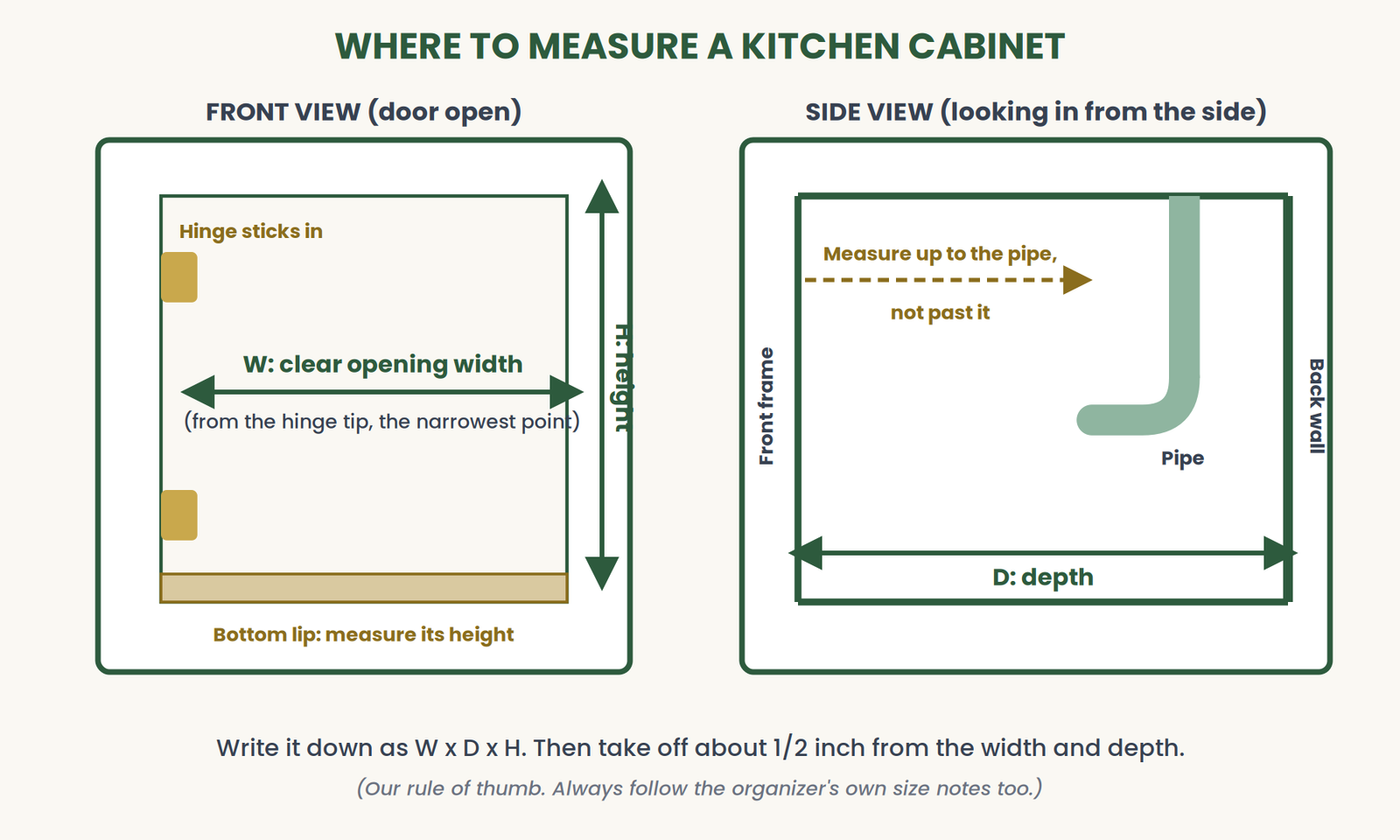
Measure the narrowest part of the opening, the depth to the first obstacle, and the height to the lowest obstacle.
Before you start, grab a tape measure, a pencil, and paper (or your phone's notes app). Open the cabinet door all the way.
Find the narrowest point of the opening. That is often from the tip of a hinge to the other side of the frame, not the width of the cabinet inside.
An organizer has to pass through this gap to get in.
Write the number down as W.
Measure from the front edge of the opening to the back wall. If a pipe, outlet, or shelf support sticks out, measure up to it, not past it.
Write the number down as D.
Measure from the cabinet floor to the lowest thing above it, such as a shelf, a pipe, or a garbage disposal. In a cabinet with shelves, measure the gap between two shelves.
Write the number down as H.
Many cabinets have a raised lip or a center bar (a stile) near the front. Measure its height, since a drawer or basket must clear it.
Also note hinges, door stops, and pipes, and mark where they are on your sketch.
Take about 1/2 inch off the width and depth. This is our rule of thumb, so the door can close and the organizer isn't wedged in.
Check the organizer's own listing for its size notes, too. Then measure everything twice before you order.
The metal hook on the end of a tape measure wiggles on purpose. It moves by about its own thickness, so inside and outside measurements both read right (This Old House explains why). Don't try to fix it.
When you measure inside a cabinet with the tape case against one wall, add the case length. Many tapes print it on the case, so check yours.
Face-frame cabinets have a wooden frame around the opening, so the opening is smaller than the inside. Frameless cabinets have no frame, so the opening is usually as wide as the inside.
Each tool does a different job, so you don't need all five. Most people only need one or two.
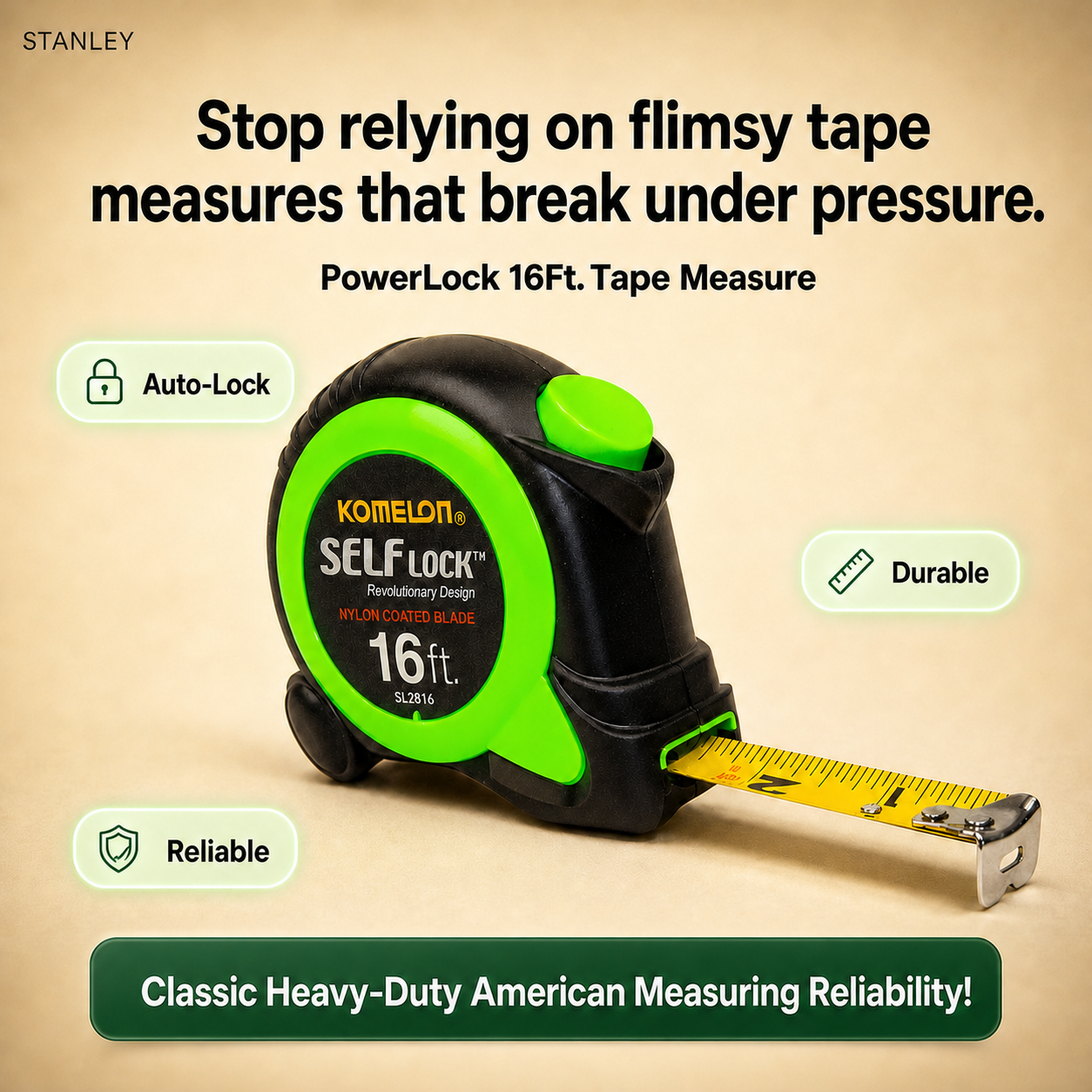
Cabinets are awkward to measure alone because the tape keeps sliding back. A self-locking tape holds the blade in place when you let go so you can read the measurement with both hands free.
For most kitchen cabinets, the 16 ft. size is plenty.
• Hands-free reading.
• 16 ft. is enough for most cabinets.
• Rubber-covered case helps your grip.
• The 3/4 in. blade on the 16 ft. model doesn't reach out as far as a wider blade.
• Remember to release the lock before you retract it.
That the size you select shows the length you want, and check the blade width for that size.
Check Price on Amazon 🛒
A folding rule is stiff, so you can push it into a cabinet and it stays straight. That makes it handy for measuring inside width, height, and depth.
Its inside-reading scale is made for measuring between two surfaces.
• Stays straight inside a cabinet.
• No batteries.
• Locking joints hold the angle you set.
• Only 6 ft long, so use a tape for longer runs.
• Bulkier to carry than a tape.
That the style you select says Inside Read and that the length is 6 ft.
Check Price on Amazon 🛒
A folding rule is stiff, so you can push it into a cabinet and it stays straight. That makes it handy for measuring inside width, height, and depth.
Its inside-reading scale is made for measuring between two surfaces.
• Easy-to-read numbers.
• Helpful if fraction marks are hard to read.
• No cords to deal with.
• Needs batteries.
• One independent reviewer notes that pulling the tape out too fast can throw off the reading.
That the listing shows Add to Cart (this model is sold by a third-party seller) and read the battery and mode notes.
Check Price on Amazon 🛒
A steel tape can't bend around a round pipe or a curved sink bowl. A soft cloth tape wraps around them.
This one has fractional inches on one side and metric on the other, so it is easy to read for home projects.
• Wraps around pipes and curves.
• Reads in fractions, not decimals.
• Lightweight.
• Soft tapes sag, so they are not good for long straight runs.
• Hold the start point firmly, since a soft tape can slip.
That the page shows the 60 in. fractional version (model TR-16-frac) and the pack size you want.
Check Price on Amazon 🛒
A laser measure sends a beam to the far wall and shows the distance. You can measure a deep cabinet or a whole kitchen wall in a second.
Use it together with a tape measure: a laser is great for depth and long distances, but a tape is better for tiny gaps.
• One person can measure.
• Quick readings.
• Long range.
• Needs batteries.
• A laser needs a flat surface to bounce off, so shiny or angled surfaces can confuse it.
That the page says GLM165-40, and confirm the accuracy and minimum distance in the specs.
Check Price on Amazon 🛒A simple starter kit: a self-locking tape (1) and a soft tape (4). Add a folding rule (2) if you measure inside a lot of cabinets.
Measure the opening width, the depth, the height, and the bottom lip. Take about 1/2 inch off, write it all down, and measure twice.
👉 Next step: put your numbers to work with our 10 best under-sink organizers.